
Foil The foil used by fencers today is the modern version of the practice weapon used by 18th century gentleman to train for duels. The target area for modern foil is said to come from a time when dueling to the death was the norm, hence, the favored target area is the torso, where the vital organs are.
To score hits with the foil, the fencer must land the tip of the blade on a valid target: along the torso from shoulders to groin in the front and to the waist in the back. The arms, neck, head and legs are considered off-target. Off-target hits will temporarily halt the fencing action, but does not change the score. The right-of-way rule states that the fencer who started to attack first will receive the hit provided it is on target, and that their opponent is obligated to defend themselves. However, if a fencer hesitates for too long while advancing, they give up right-of-way to their opponent. An attack which has failed (i.e. has missed or been parried) is no longer an attack. Priority does not automatically pass to the defending fencer, and at the moment an attack is over, neither fencer has priority. Instead, priority is gained by a fencer making an offensive action. If the attack was parried, the defender has the right to make a riposte, but it must be initiated without indecision or delay. Alternatively, he may initiate his own attack if the initial attack missed. The fencer making the original attack may also make a new offensive action, a renewal of the initial attack.
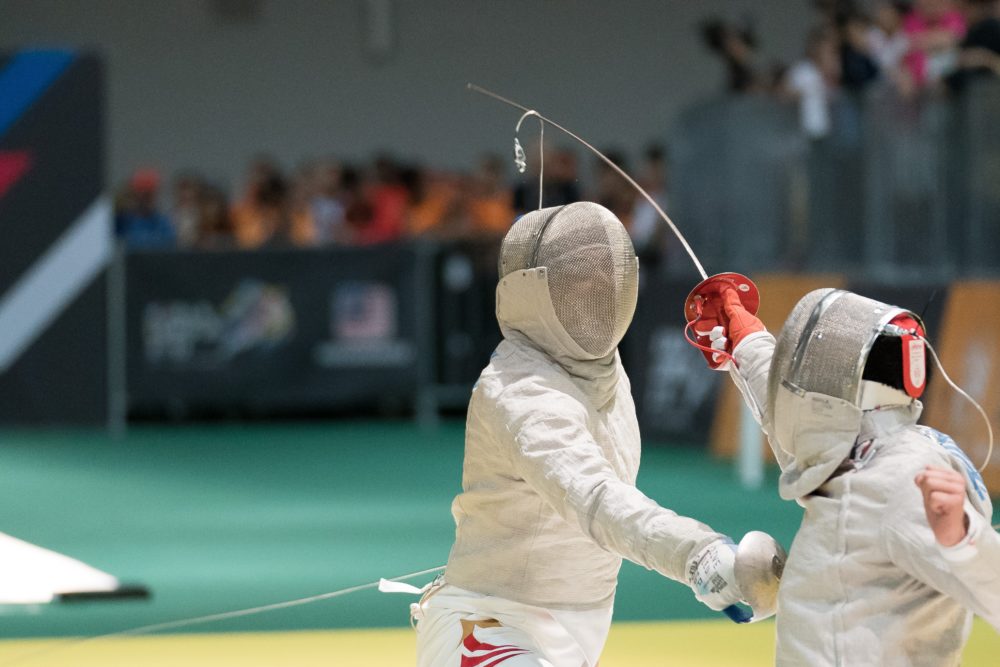
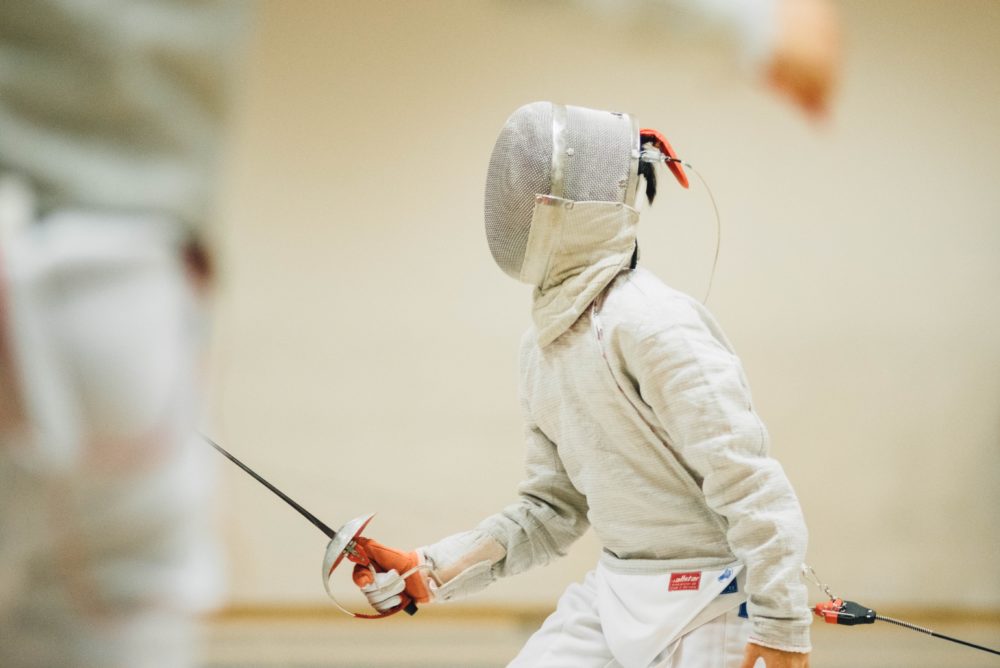
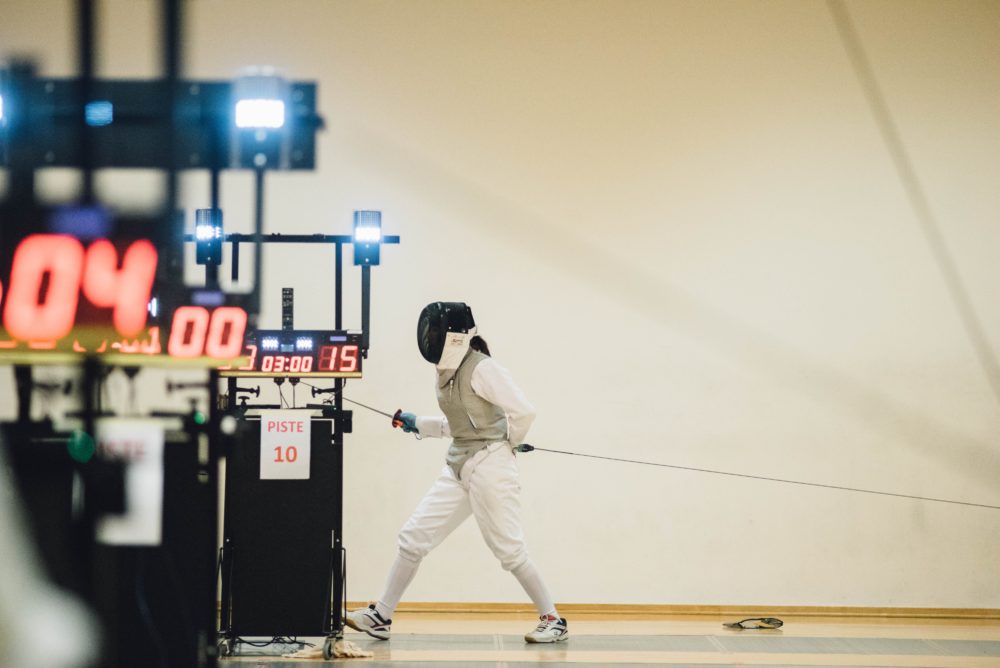
Because of the rapidity with which actions in foil fencing are executed it is common for both fencers to believe their attack had priority!
Epee (“EPP-pay”, french for sword) as the epee evolved, the idea was to develop epee fencing in a manner that reproduced the conditions of an actual duel to ‘first blood’, a much more skillful duel. As a result, in epee the entire body is considered a valid target, there are no rules of priority, and the first to hit gets the score. If the fencers hit each other within 1/25th of a second, both receive a hit – a double hit. The lack of right-of-way combined with a full-body target naturally makes epee a game of careful strategy and patience – so, rather than attacking outright, epeeists spend time probing their opponent’s defences and manoeuvring for distance before risking an attack.
Sabre The sabre is the modern version of the slashing cavalry sword, and thus a score can be made with the side of the blade and the point. Sabre attacks tend to be very fast and employ rules of right-of-way, which are very similar to foil, but with some subtle differences. Like foil, the fencer who starts to attack first is given priority, should his opponent counter-attack. However, sabre referees are much less forgiving of hesitation by an attacker. The target area is the entire body above the waist and because the head is a valid target area, the fencer’s mask is also electrically wired. One significant departure from foil is that off-target hits do not register on the scoring machine, and therefore do not halt the fencing action. All sabres use the French grip due to the shape of the guard which protects the hand.
Wheelchair Fencing Originally devised at Stoke Mandeville Hospital competitive wheelchair fencing was first introduced in 1953 and has been a Paralympic sport since Rome in 1960. The sport is now practised in 25 countries worldwide. Unlike able-bodied fencing, wheelchair fencing is static: the fencers are clamped to the piste using a metal frame. Beyond this, the sport is largely similar to its able-bodied counterpart.
In order to compete in wheelchair fencing athletes compete while sitting in a wheelchair. Athletes who have had a spinal cord injury (quadriplegic and paraplegic), athletes with lower leg amputations, athletes with cerebral palsy and athletes with other physical disabilities which require the use of a wheelchair are all eligible to compete in wheelchair fencing.
There are three classes in wheelchair fencing to ensure equal competition:
- Class A incorporates those athletes with good balance and recovery and full trunk movement;
- Class B those with poor balance and recovery but full use of one or both upper limbs;
- Class C athletes with severe physical impairment in all four limbs.